How is Montessori teacher training unique from traditional teacher training? Some people compare Montessori teachers to waiters. Like waiters, Montessori teachers observe their students from across the room, only checking in when necessary. Similar to waiters who suggest menu items they think diners would enjoy, Montessori teachers offer lessons they think the child will enjoy. Montessori teacher training helps future teachers build the necessary skills to be an excellent “waiter,” supporting each child’s academic journey while also enjoying the learning process.
During Montessori teacher training, you’ll discover the Montessori philosophy, classroom management skills, Montessori materials, and more. If you’re interested in starting your Montessori journey, here’s a closer look at some of the skills you’ll gain.
Skills Learned in Montessori Teacher Training in Pickering, Ontario
In a Montessori classroom with trained teachers, children work happily, learning to read, performing math operations, and even cleaning the classroom. If you popped your head in, you might not even be able to tell where the teacher is! She might be sitting on the floor, giving a lesson to one student. Or, she might be sitting in a chair in the corner, observing the children as they work.
This is a special feature of Montessori classrooms. Dr. Montessori once wrote, “The greatest sign of success for a teacher… is to be able to say, ‘The children are now working as if I did not exist.'” It may sound like an unreasonable reality that children would work without an adult telling them what to do.
How do Montessori teachers make this happen? Every Montessori teacher has a unique skill set that they develop through training, practice, and experience. Here’s an overview of the skills you’ll learn when you begin Montessori teacher training.
How to Put Montessori Values into Practice
One of the main goals of Montessori teacher training is to give future teachers a deep understanding of the Montessori philosophy and values. These values include:
- Respect for the child
- Supporting the child’s independence
- The absorbent mind
- The prepared environment
- Hands-on learning
- Supporting intrinsic motivation
- Holistic education, including social and emotional development
During training, you’ll learn about the Montessori principles and how to put them into practice. The philosophy is the underpinning of everything Montessori teachers do. That’s why most training programs emphasize the core principles and methodology of Montessori education.
How to Use Montessori Materials
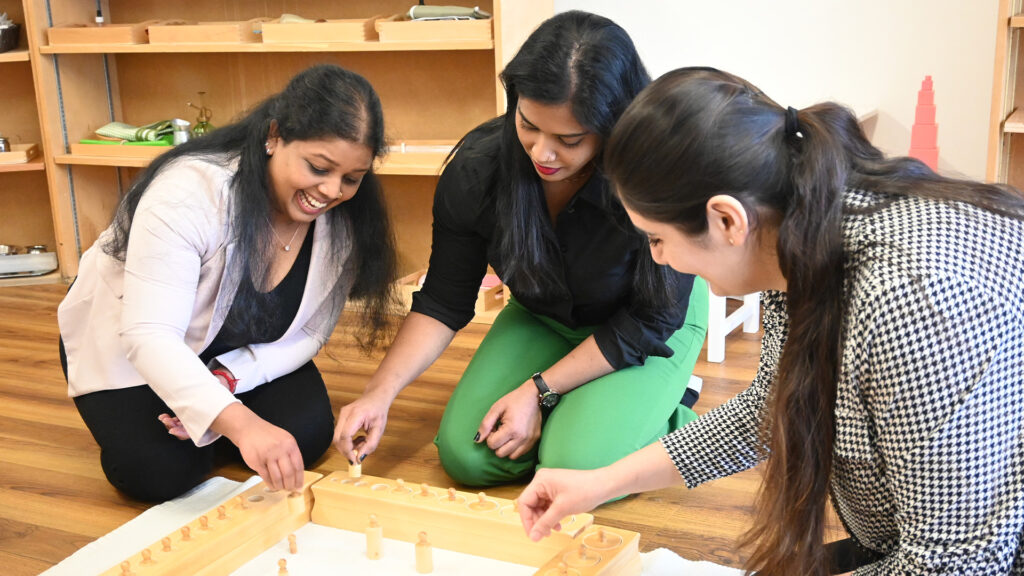
Learning to use Montessori materials is an essential part of Montessori teacher training in Pickering, ON. In Montessori classrooms, children work with hands-on materials like the dressing frames or sandpaper letters. Working with materials is integral to Montessori. While working with materials, children develop independence, learn through the five senses, and achieve mastery through child-directed learning.
However, for children to gain all the benefits of Montessori materials, teachers need to present and demonstrate their proper use. Plus, teachers need to learn when to present each material and what to do after the child masters every concept. You’ll learn all these details, and more, in Montessori teacher training.
How to Create a Beautiful Montessori Classroom
When you walk into a Montessori classroom, you’ll find a space that’s calm, relaxing, beautiful, and engaging all at the same time. You’ll also likely find a cozy reading corner, a vase of flowers, and even a few plants. Amongst shelves lined with interesting materials, you’ll also find carpets, spaces for movement, and artwork. Every Montessori classroom is unique because it reflects the needs of the students.
As a part of your training, you’ll learn the best practices for setting up a Montessori classroom.
Montessori Classroom Management Skills
Classroom management skills are what make it possible for Montessori classrooms to become productive spaces where children work, explore, and learn. The ultimate goal, as Dr. Montessori said, is for children to work as if no teacher were present at all.
It may sound counterintuitive that children would work with no teacher present, but with effective classroom management, children become what Dr. Montessori called “normalized.” In other words, children become well-adjusted members of the classroom community who work, help others, and keep the classroom neat and clean.
It takes children time to become adjusted to the Montessori classroom. This is where classroom management skills are especially important. In the Montessori classroom, teachers use techniques such as redirection, modeling, and gluing.
However, Montessori classroom management also involves many preventative strategies. Dr. Montessori once wrote, “The child who concentrates is immensely happy.” When children are happy and concentrating, they are less likely to behave in ways that are disruptive or challenging in the classroom. This means teachers monitor the classroom to ensure there are always enough interesting, engaging activities available to children.
How to Offer a Calm Presence in the Classroom
As a child, did you ever have a teacher who walked into the classroom and transmitted instant calm? The classroom would get quiet, and everyone would wait for the teacher to address the class.
During Montessori teacher training, you will learn how to offer a calm presence in the classroom. The goal isn’t to scare children into being quiet, but to bring a spirit of calm and respect. The teacher’s energy can quickly rub off on the children, so cultivating a calming presence is important.
Observation Skills
In the Montessori classroom, observation skills are essential. Through observation, you can gain many insights into the children in your care.
For example, you can learn about each child’s interests and needs. You can also discover their strengths, skills, and the best lesson to offer them next.
As a part of Montessori teacher training, you’ll learn not only what to look for but also how to track your observations. Each school may track differently, but you’ll get a sense of how these systems work and what you should track.
Additionally, you’ll learn to use observation to make adjustments to the classroom. For example, if you notice children ignoring one area of the classroom, why might that be? During training, you’ll gain insights into whole-classroom observations and how to make useful, effective changes.
When to Step In and When to Observe
One of the key skills Montessori teachers must learn is when to intervene. When teachers interrupt children unnecessarily, they may disturb the child’s concentration. Additionally, interruptions can make it difficult for the child to develop intrinsic motivation. Instead of working for the joy of it, they’ll constantly look to the teacher for approval.
Dr. Montessori explained, “Praise, help, or even a look, may be enough to interrupt him, or destroy the activity…The great principle which brings success to the teacher is this: as soon as concentration has begun, act as if the child does not exist. Naturally, one can see what he is doing with a quick glance, but without his being aware of it.”
That said, there are also moments when it is important to intervene. For example, if a child is disturbing others or is in danger, there are appropriate ways to intervene. Through Montessori teacher training, you’ll learn to identify how and when to step in.
Montessori Teacher Training in Pickering, ON with Montessori Mantra Teacher’s Training College
At Montessori Mantra Teachers’ Training College, you’ll learn all of the above and more! We offer a variety of Montessori courses appropriate for teachers, caregivers, and those interested in a career change.
All our programs are in person, providing invaluable hands-on experiences that will help you build your skills. Our Certified Montessori Educator Diploma course is a comprehensive 9-month program that also includes a supervised 500-hour practicum. This ensures you can see and participate in a working Montessori classroom. Our graduates can step into a new role as a Montessori teacher with confidence in their knowledge and skills.
Get in touch to learn more about our programs and which is the best fit for you!