
If you were a fly on the wall in a Montessori classroom, what would you see? You’d probably be surprised at how quiet and calm the classroom is, despite the fact that the students are three to six years old.
One child sits at a table and methodically threads beads on a shoestring. Other children sit together reading a book. Another child carefully builds a tower using wooden blocks. Yet another child sweeps up a spill with a child-sized dustpan and brush.
You look around and finally find the teacher, sitting in a corner giving a lesson to a small group of students. She’s not at the front of the room, directing the children and making sure they keep quiet. Yet, the room is calm, happy, and productive. How does this work?
At Montessori Mantra Teachers’ Training College, we show teachers how to foster calm in their classrooms. In our Montessori training programs in Durham, future educators learn essential classroom management skills and strategies. Read on to discover how the Montessori method creates the conditions for calm, happy learning.
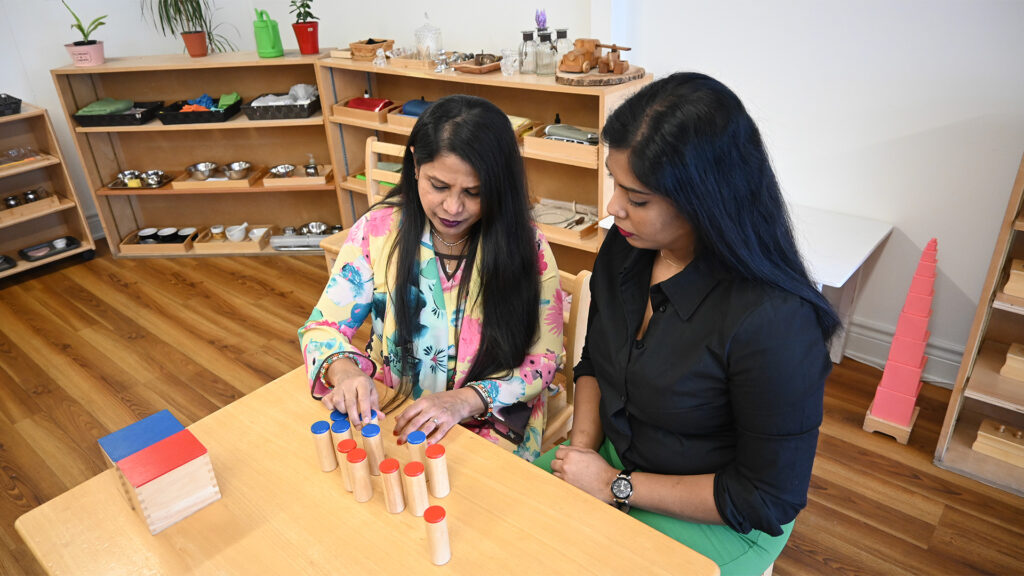
What is Normalization in Montessori?
The classroom scene above describes children who are “normalized.” Dr. Montessori used this term to describe children’s behavior when they can choose meaningful work, concentrate, and respect other students, as well as the classroom.
In her own words, Dr. Montessori said, “…their excited fantasies and their restless movements disappear altogether; a calm, serene child, attached to reality, begins to work out his elevation through work. Normalization has been achieved.”
In other words, children who are normalized enjoy working. They don’t run around the classroom, interrupt others, or cause chaos. Instead, they voluntarily choose to concentrate on a variety of classroom projects and activities.
Dr. Montessori believed that children are only restless or show poor behavior when their needs aren’t being met. That’s why in the Montessori method, teachers spend time observing children to understand their needs. They also use other strategies to help children become normalized.
The Montessori classroom helps children achieve normalization with a few key elements:
- The Prepared Environment: The classroom must be filled with interesting and engaging activities that support the child’s development.
- Freedom: Children must be free to choose their activities.
- Modeling: Montessori classrooms are mixed-age. So, the older children model how to behave and work to the younger children. This helps create a productive environment.
- Guidance: Teachers provide lessons on basic skills like “How to interrupt politely,” “How to walk around a work mat,” and “How to ask for a turn.” These lessons prevent conflict and promote a harmonious classroom.
How Choice and Freedom Lead to Calm in Montessori Classrooms
One of the main differences between Montessori and traditional education is that in Montessori classrooms, children are allowed to choose their lessons and activities. In the classroom, there are shelves with trays and baskets. Each tray contains an activity or material. Children are free to choose any of the materials that they have already had a lesson on and know how to use.
It may seem counterintuitive, but having the freedom to choose activities and lessons fosters calm in the classroom. It’s similar to how you probably prefer to live your life. Imagine you have a list of chores you want to get done. What if you weren’t allowed to decide what order to complete your tasks? It probably wouldn’t feel too good to have someone dictate every part of your day for you.
Instead, you probably think through your day and plan for yourself. For example, you might want to go to the grocery store early because there are fewer shoppers and less traffic. Or, you might feel more alert to manage banking and bills in the morning and prefer to do gardening in the evening.
The same is true for children. When they choose their activities, they’re motivated and interested in working. This leads to a calm, productive classroom because children are busy and concentrating, making them less likely to get into trouble or interrupt other children.
Freedom within Limits
In the Montessori classroom, freedom doesn’t mean children can do anything they want at all. It simply means they can choose from the prepared activities within the classroom. Also, children must follow basic rules or norms. The main rule is to respect the classroom and others. This means caring for the classroom, the materials, and treating other students with care.
Classroom Management in Montessori Classrooms
Classroom management in Montessori classrooms also supports a calm environment. Here are a few strategies Montessori teachers use:
Preventing Behavior Problems the Montessori Way
In the Montessori method, teachers prevent classroom management issues before they even begin. One major aspect of this is the classroom itself, known as the “prepared environment.”
Dr. Montessori explained, “Naughtiness will disappear if we give children the right environment at a sufficiently early age. This environment must provide a great deal of mental food and warm, loving treatment.”
In other words, the classroom must be filled with engaging, exciting activities for children to enjoy. Children should come into the classroom excited to use the materials and enjoy the available activities. This means teachers are constantly observing the space and adding new activities that meet the children’s needs.
Learn more about how to set up a Montessori classroom here.
Redirecting and Gluing: Montessori Discipline Techniques
What about children who are struggling to concentrate or who don’t follow the rules? Montessori teachers use different techniques to support children in these moments.
Usually, the teacher redirects the child first. This means you remind the child what they should be doing. For example, “What would you like to work on now?” or “Would you like me to help you find some work?”
For children who need more support, the teacher might try gluing. To “glue,” the teacher keeps the child close to her for a short period. They might watch her give a lesson to another child or help her with another task. Sometimes, watching another child involved in work can help inspire them. Then, the teacher helps the child find some work to do.
Peace Education in the Montessori Classroom
In addition, the Montessori curriculum includes a peace education component. Through peace education, children learn skills like self-regulation, how to manage conflict, and how everything in the world is connected.
Many Montessori classrooms have a peace corner or area where children can go when they feel sad, upset, or angry. This offers children something productive to do with their emotions. They can take a moment to regulate by looking at images, practicing breathing, or just taking a moment.
Learn to Create a Calm Classroom with Montessori Training in Ontario
Would you like to bring the calmness of Montessori to your classroom? Many of the methods and strategies used in Montessori classrooms can be applied to any early childhood classroom.
At Montessori Mantra Teachers’ Training College, we offer various training programs. Sign up for our MACTE-accredited Montessori Early Childhood Diploma Course or register for our Montessori Assistants’ Course.
Our Montessori training programs are held in person and provide valuable hands-on experience. You’ll learn how to create a calm, productive classroom. Additionally, you’ll learn important classroom management strategies.
Explore our MACTE-accredited Early Childhood Diploma Course to learn more about this comprehensive training program. Have questions? Get in touch, and we’ll be happy to answer your questions and guide you through the application process.